
Putting a language model into a business process involves a structural architecture choice — one that will determine your costs, your confidentiality level and your room for maneuver for years. Three options dominate, each with its strengths and trade-offs.
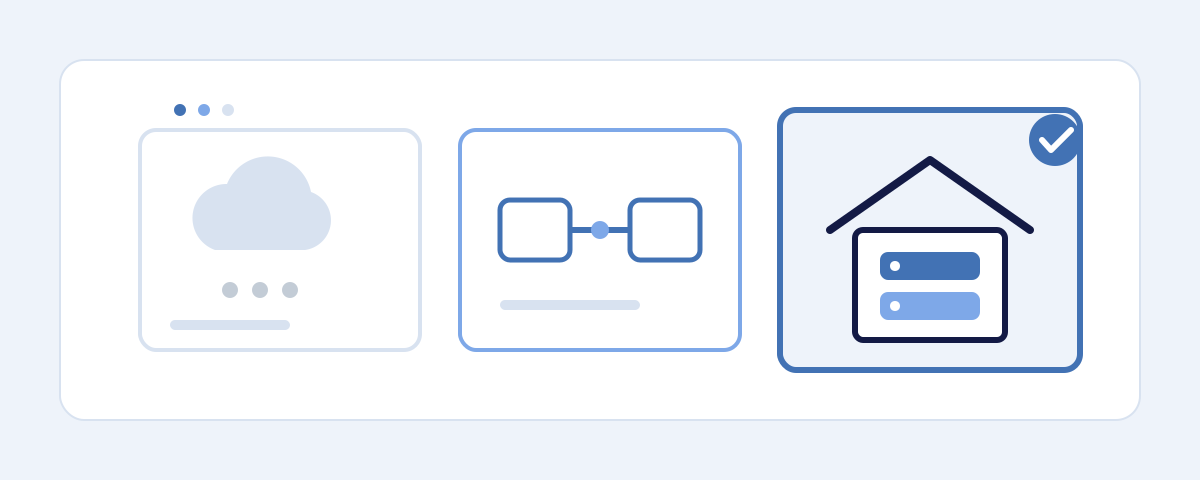
Option 1: public tools (consumer chatbots)
Fast to adopt, no integration: every employee just opens a browser and works. That's also their limit — AI stays next to your processes, never inside them.
- For: zero entry cost, discovering use cases, team awareness.
- Against: no integration with your systems, no traceability, risk of leaking confidential data, results that vary from one employee to the next, nothing capitalized.
Verdict: useful for awareness and generic tasks on public data. Insufficient for a business process.
Option 2: proprietary model APIs
Your applications call a vendor's model through an API. This is the fastest route to real integration: the model slots into your workflows, under your rules.
- For: state-of-the-art quality, instant scalability, no infrastructure to manage, fast iteration.
- Against: your data passes through a third party (with contractual guarantees that vary by offer), per-request costs that grow linearly with usage, dependency on the vendor's pricing and technical roadmap.
Verdict: relevant for fast prototyping and value validation, and for moderate volumes on low-sensitivity or properly pseudonymized data.
Option 3: a model hosted on your premises
An open model deployed on your servers or private cloud, integrated with your tools. This is the "your AI, custom-built, at home" option.
- For: your data never leaves, fixed and predictable costs at high volume, deep customization (vocabulary, rules, internal documents), vendor independence, simplified compliance (no processor to contract).
- Against: higher initial investment, requires deployment and monitoring skills — in-house or supported.
Verdict: the right choice as soon as data is sensitive, volumes are steady, or AI becomes a durable component of your processes.
The comparison at a glance
| Criterion | Public tool | Proprietary API | Hosted on-premises |
|---|---|---|---|
| Confidentiality | Low | Medium (contractual) | Maximum |
| Cost at low volume | None | Low | Medium |
| Cost at high volume | — | High and growing | Fixed and predictable |
| Integration with your tools | None | Good | Total |
| Customization | None | Limited | Deep |
| Vendor dependency | High | High | Low |
| Time to deploy | Immediate | Weeks | Weeks to months |
The questions that settle it
- What happens if this data leaks? If the answer hurts (customer data, health, HR, trade secrets), self-hosting is the answer for that scope.
- What volume at 12 months? Estimate API costs at target volume — not pilot volume. The economic tipping point often arrives sooner than expected.
- Is AI a test or a durable component? You don't build a core process on a dependency you don't control.
- Who will operate the system? Without internal skills or a partner, poorly maintained self-hosting becomes a risk of its own.
In practice: a hybrid trajectory
Most companies benefit from combining: prototype on APIs to validate value quickly, then migrate validated, sensitive processes to an internally hosted model. Generic, low-stakes uses can stay on APIs.
The key is designing the integration from day one so this migration stays possible: an abstraction layer between your applications and the model, standard exchange formats, and test suites that let you compare models objectively. That's an architecture choice, not luck — and it's exactly the kind of decision worth making before the first project, not after the tenth.